

glossary
Playable Engagement Time
Quick Definition Playable Engagement Time measures how long users actively interact with a playable ad before deciding to install or exit. This metric reveals whether your playable holds attention long enough to demonstrate value and drive quality installs. 01. What is Playable Engagement Time Playable Engagement Time tracks the duration users spend actively playing with […]
Quick Definition
Playable Engagement Time measures how long users actively interact with a playable ad before deciding to install or exit. This metric reveals whether your playable holds attention long enough to demonstrate value and drive quality installs.
What is Playable Engagement Time
Playable Engagement Time tracks the duration users spend actively playing with your interactive ad. From first tap to install decision, every second counts.
Unlike passive video ad views, engagement time captures real interaction. Taps, swipes, drags, level completions. If the user’s hands are on the screen, the clock is running.
This metric matters because it reflects genuine interest. Users who engage longer typically convert at higher rates and deliver better LTV.
Why Engagement Time Matters
Engagement time separates tire-kickers from real prospects.
Users who bounce after 3 seconds didn’t experience enough gameplay to understand your game’s value. They’re unlikely to install, and if they do, retention suffers.
Users who play for 20-30 seconds have experienced your core mechanic. They’ve felt the satisfaction loop. They know what they’re getting.
Engagement time correlates directly with install quality: users who make it deeper into a playable have already self-selected for interest in the game. Longer engagement tends to predict higher LTV users. The playable acts as a quality filter, attracting players who actually want what you’re offering.
Industry Benchmarks
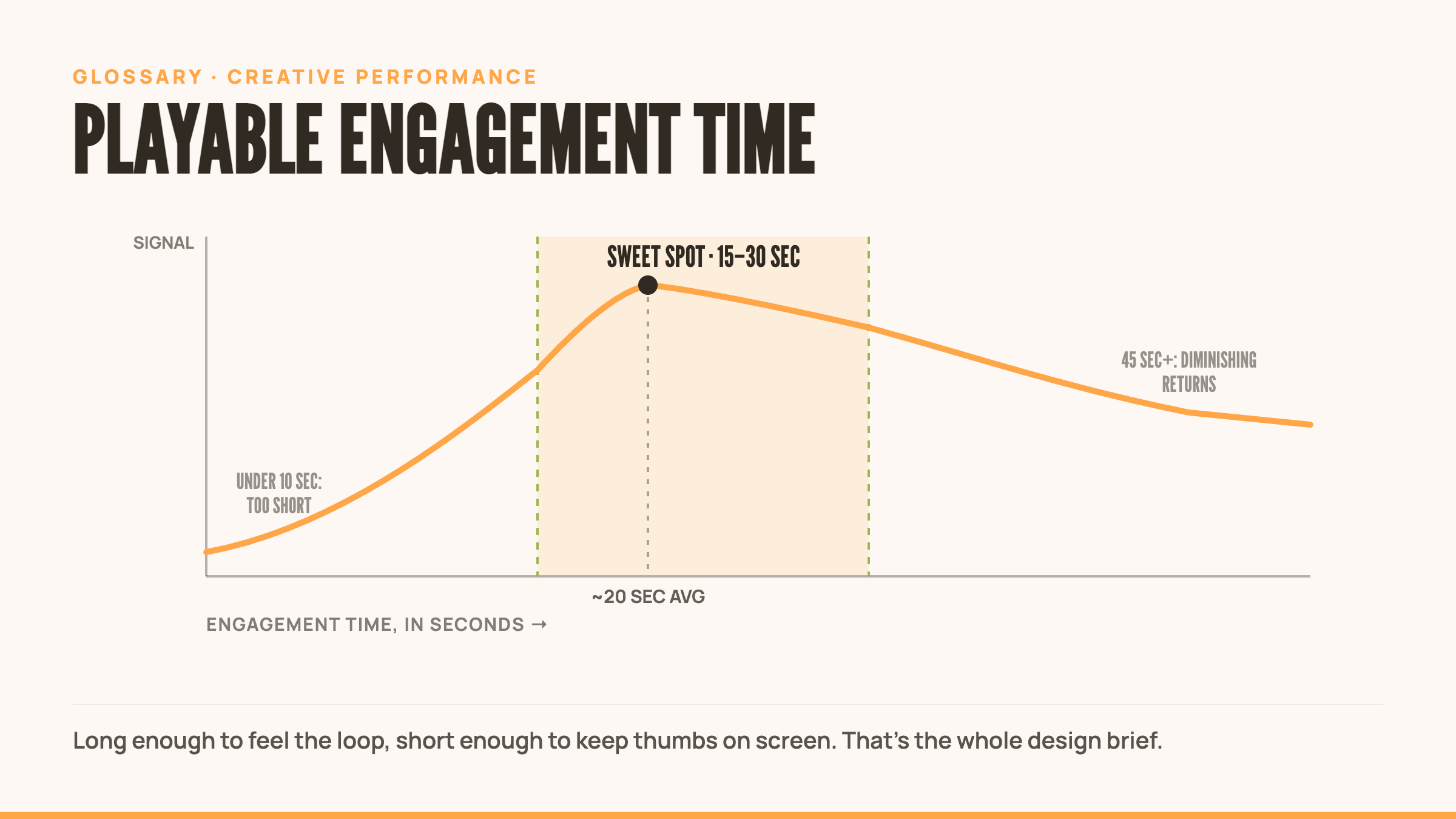
Most playable ads clock 15-45 seconds of engagement, with 20 seconds as the sweet spot.
Engagement Duration:
- 15-30 seconds: Optimal range for most game genres
- 20 seconds average: Industry standard for successful playables
- Under 10 seconds: Too short to demonstrate value
- Over 45 seconds: Diminishing returns, higher drop-off risk
Engagement Rate:
- Engagement rate varies widely by genre, network, and creative quality
- Interactive formats see meaningfully higher engagement than static or video ads — commonly cited at up to 3x
- Playables lift install rates by up to 40% vs. video
Quality Metrics (industry-reported ranges — varies by genre and region):
- 15-25% higher Day-1 retention for playable installs
- 20-30% higher Day-7 retention vs. standard UA channels
- Shorter playables (15-20 seconds) commonly outperform 25+ second versions on CTR in creative testing — the gap varies by game and network, so test your own duration variants
Optimizing Engagement Time
Start with the core mechanic. No tutorials, no story setup. Get users playing within 2 seconds.
Cut the fat:
- Skip intro animations
- Eliminate text instructions
- Use visual cues instead of static panels
- Tutorial by doing, not telling
Find your optimal length: Test different interaction durations. Fewer, well-designed interactions often outperform more of them — once users understand the mechanic and complete a level, they’ve got what they need to decide.
Monitor drop-off points: Track where users exit. If 80% bail at 12 seconds, something breaks at that moment. Fix the difficulty spike, clarify the objective, or adjust the pacing.
Quality over quantity: A 20-second playable that keeps 70% of users engaged beats a 45-second experience that bleeds users after 15 seconds.
Common Mistakes
Too much tutorial. Users don’t want a lesson. They want to play. Static instruction screens kill momentum and add friction.
Wrong difficulty curve. Too easy and users get bored. Too hard and they feel incompetent. Find the Goldilocks zone where players feel smart and capable.
Forgetting the end card. Users barely glance at end card copy. Make it visual, make it punchy, make it fast. The CTA is the whole point.
Ignoring load times. Slow playables bleed users before they even start. Keep HTML5 ads under 1 MB for fast loading.
One-size-fits-all duration. Puzzle games can hold attention longer than hyper-casual. Match your engagement time to your genre and mechanic complexity.
Related Terms
- Playable Ads – Interactive ad format letting users experience gameplay before installing
- Playable Conversion Rate – Percentage of playable engagers who install
- Session Duration – How long users play after installing (different from ad engagement)
External Resources
- AppLovin: Mobile Playable Ads Guide
- Supersonic: 3 Hyper-Casual Playable Ad Metrics You Should Be Analyzing
- Activision Blizzard Media: Best Practices for Playable In-Game Ads
Frequently Asked Questions
What’s the ideal playable engagement time?
15-30 seconds for most game genres. Long enough to demonstrate your core mechanic, short enough to hold attention. Test your specific creative to find the optimal duration for your genre.
Does longer engagement always mean better performance?
No. Engagement time should match your game’s complexity. Hyper-casual performs best at 15-20 seconds, while simulation or puzzle games can justify 30-45 seconds if the experience stays engaging. Returns diminish past 30 seconds for most genres.
How does engagement time affect install quality?
Users who engage longer typically deliver higher LTV. They’ve experienced your gameplay and understand what they’re installing before they tap the CTA, which filters out low-intent installs.
What counts as engagement time in a playable ad?
Any active interaction: taps, swipes, drags, and level completions. If the user’s hands are on the screen, the clock is running. Passive video views don’t count the same way.