

glossary
CPM (Cost Per Mille)
Quick Definition: CPM is the cost to serve 1,000 ad impressions. The pricing model advertisers use when buying reach at scale. — 01. What is CPM? CPM stands for Cost Per Mille. Mille is Latin for thousand. You pay for every 1,000 times your ad shows up, whether anyone clicks or not. This is the […]
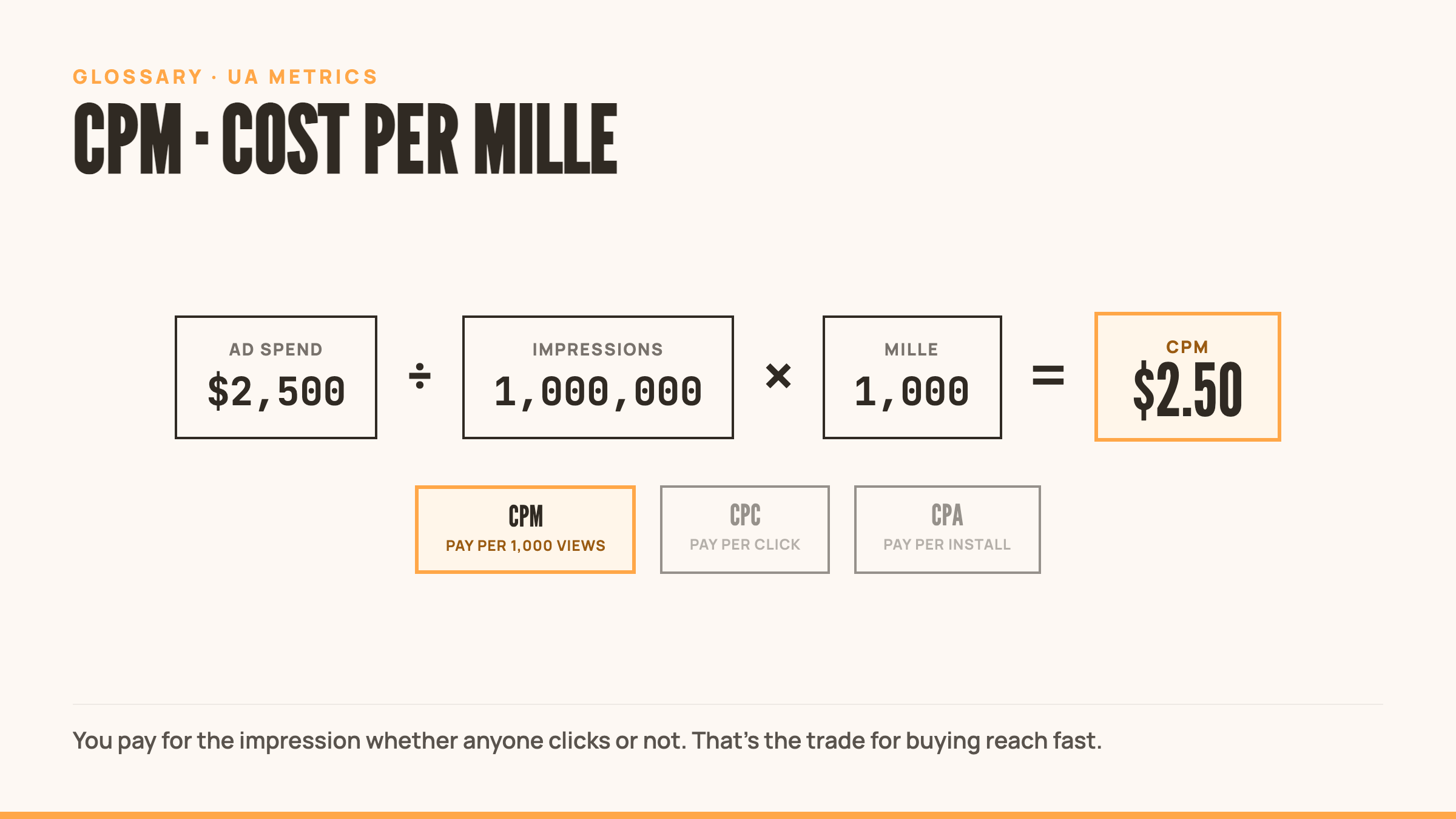
Quick Definition: CPM is the cost to serve 1,000 ad impressions. The pricing model advertisers use when buying reach at scale.
What is CPM?
CPM stands for Cost Per Mille. Mille is Latin for thousand. You pay for every 1,000 times your ad shows up, whether anyone clicks or not.
This is the foundational metric for brand awareness campaigns. You’re buying eyeballs, not actions. The goal is reach and frequency, not conversions.
In mobile gaming UA, CPM matters most during launch phases or when testing new creative. You want to blast visibility fast and see what resonates.
The trade: You pay for exposure, period. Someone scrolls past your ad? You paid for that. Someone taps but bounces? You paid for that too.
How to Calculate CPM
The formula:
CPM = (Total Cost / Total Impressions) × 1,000
Example:
- Campaign budget: $1,000
- Impressions delivered: 1,000,000
- CPM: ($1,000 / 1,000,000) × 1,000 = $1.00 CPM
You spent one dollar for every thousand people who saw your ad.
Reverse calculation (estimating campaign cost):
- Target impressions: 5,000,000
- Platform CPM: $2.50
- Estimated cost: (5,000,000 / 1,000) × $2.50 = $12,500
CPM vs Other Pricing Models
Different pricing models serve different goals. Here’s when to use each.
CPM (Cost Per Mille)
You pay for: Impressions (views) Best for: Brand awareness, reach campaigns, creative testing at scale Risk: You pay whether people engage or not
CPC (Cost Per Click)
You pay for: Clicks Best for: Driving traffic, measuring interest Risk: Clicks don’t guarantee installs or conversions
CPA (Cost Per Action)
You pay for: Specific actions (installs, registrations, purchases) Best for: Performance campaigns with clear ROI targets Risk: Higher CPAs, limited scale, requires conversion tracking
Rule of thumb: Use CPM when you need fast reach. Use CPC when you want engaged traffic. Use CPA when you need measurable outcomes.
Factors Affecting CPM
CPM isn’t static. It fluctuates based on supply, demand, and targeting precision.
Platform
Different ad networks price differently. Meta, AppLovin, Unity, Google all have unique auction dynamics and inventory costs.
Geography (GEO)
Tier 1 markets (US, UK, Canada) cost more than Tier 2 or Tier 3. You’re bidding against higher competition for wealthier audiences.
Device Type
Mobile CPMs typically run higher than desktop. Screen real estate is limited. Ad placements are scarce. Scarcity drives price.
Seasonality
Q4 (holidays) sees CPM spikes. Tax season, back-to-school, major game launches all increase competition and inflate costs.
Ad Quality & Relevance
Platforms reward engaging, high-quality ads with lower CPMs. Better relevance scores mean cheaper impressions.
Audience Targeting
The tighter your targeting, the higher your CPM. Niche audiences cost more because fewer people match your criteria.
Common Mistakes
Optimizing for CPM Alone
Low CPM means nothing if your creative is trash. You bought cheap eyeballs that convert at 0%. Focus on effective CPM (eCPM) and downstream metrics like CPI and ROAS.
Ignoring Creative Fatigue
Running the same creative too long drives CPM up as frequency increases. Platforms penalize stale ads. Rotate creative to keep CPMs stable.
Comparing CPMs Across Platforms
A $3 CPM on Meta isn’t the same as a $3 CPM on Unity. Different audiences, different engagement patterns, different conversion rates. Judge CPM within platform context.
Forgetting About Viewability
Paid for 1,000 impressions? How many were actually viewable? Industry standards say an ad must be 50% visible for 1 second. Low viewability means you’re paying for impressions no one sees.
Related Terms
- eCPM (Effective CPM): Revenue generated per 1,000 impressions (used by publishers)
- CPC (Cost Per Click): Cost per ad click
- CPA (Cost Per Action): Cost per conversion event
- CPI (Cost Per Install): Cost per app install
- Impressions: Number of times an ad is displayed
- Fill Rate: Percentage of ad requests filled with actual ads
- Viewability: Percentage of served impressions that meet viewability standards
External Resources
- Adjust: Cost Per Mille (CPM) Definition
- AppLovin: CPM & eCPM Glossary
- SplitMetrics: Cost Per Mille (CPM) Explained
Frequently Asked Questions
What’s a good CPM for mobile game ads?
Depends on GEO and platform. US iOS can range $5 to $15 CPM. Android often runs lower. Tier 2 and Tier 3 markets can fall under $2. Compare against your own platform benchmarks, not a universal number.
How is CPM different from eCPM?
CPM is what advertisers pay per 1,000 impressions. eCPM is what publishers earn per 1,000 impressions. Same formula, opposite side of the transaction.
Should I optimize campaigns for lowest CPM?
No. Optimize for outcomes. A $10 CPM that converts at high ROAS beats a $2 CPM that drives no installs. CPM is an input metric, not a success metric.
Why do mobile CPMs cost more than desktop?
Limited screen space, fewer ad placements, and higher engagement rates on mobile. Scarcity and performance both drive price up.