

glossary
MMP (Mobile Measurement Partner)
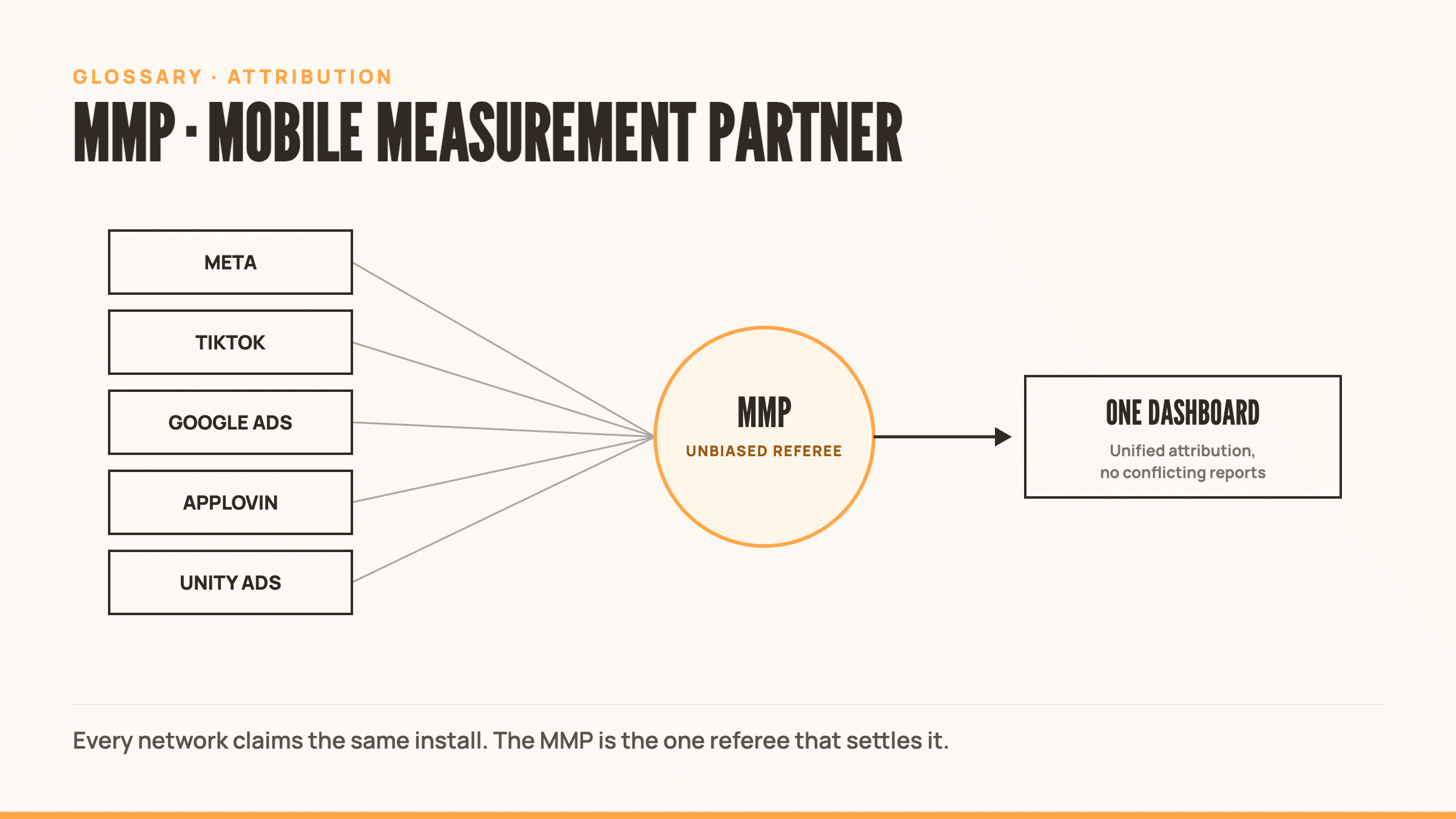
An MMP is a third-party platform that tracks and measures user acquisition performance across multiple ad networks. They act as the unbiased referee for attribution, telling you which ad network, campaign, and creative actually drove each install.
Quick Definition
An MMP is a third-party platform that tracks and measures user acquisition performance across multiple ad networks. They act as the unbiased referee for attribution, telling you which ad network, campaign, and creative actually drove each install.
What is an MMP?
An MMP, or mobile measurement partner, is your single source of truth for UA performance.
Without an MMP, you’re flying blind. You’re running campaigns across Meta, TikTok, AppLovin, Unity, and Google. Each ad network claims credit for the same install. Each dashboard shows different numbers. You have no idea what’s actually working.
MMPs solve this. They sit between your app and your ad networks. They collect data from all sources, run attribution logic, and tell you which network gets credit for each install. One dashboard. One set of numbers. No more conflicting reports.
A user sees your ad on TikTok, clicks it, then sees your ad again on Facebook, clicks that too, and finally installs your game. The MMP decides which network gets credit based on attribution rules. Last click, first click, or multi-touch. The MMP applies the logic and assigns credit.
This matters because you’re spending money across multiple networks. If you can’t measure which networks drive real installs, you can’t optimize spend. You’re guessing. MMPs turn guessing into data.
But MMPs do more than attribution. They track post-install events. Registrations, purchases, level completions, retention. They measure LTV. They detect fraud. They ensure privacy compliance. They integrate with your BI tools and ad networks so data flows automatically.
The big players are AppsFlyer, Adjust, Singular, Branch, Kochava, and Tenjin. AppsFlyer holds roughly 48% of Android installs. Adjust is a close second. Each has slightly different features, but they all solve the same core problem: unified measurement.
MMPs use an SDK embedded in your app. The SDK collects measurement and attribution data, sends it to the MMP, and the MMP processes it. You configure attribution windows (like 7-day click, 1-day view), fraud rules, and integrations. The MMP handles the rest.
Without an MMP, you’d need to manually reconcile data from every ad network, build your own attribution logic, handle fraud detection yourself, and maintain integrations as networks change their APIs. It’s not realistic at scale.
That’s why MMPs are standard in mobile gaming. If you’re spending serious money on UA, you need one.
How MMPs Work
1. SDK Integration
You embed the MMP’s SDK in your app. This SDK tracks installs, user activity, and in-app events. It communicates with the MMP’s servers to send measurement data.
2. Ad Network Integration
The MMP integrates with your ad networks. When a user clicks an ad, the network sends data to the MMP. When the user installs your app, the SDK fires. The MMP matches the install to the click and assigns attribution.
3. Attribution Logic
The MMP applies attribution rules. Last click, first click, multi-touch. You configure the attribution window (how long after a click or view does an install still count). The MMP runs the logic and credits the right network.
4. Data Collection
The SDK tracks post-install events. Registrations, purchases, level completions, retention. This data feeds into LTV calculations and cohort analysis.
5. Fraud Detection
MMPs detect install fraud. Click spam, click injection, SDK spoofing, device farms. They flag suspicious installs so you don’t pay for fake users.
6. Reporting
The MMP aggregates everything into dashboards and reports. You see performance by network, campaign, creative, cohort, and geo. You export data to your BI tools or run API queries.
7. Privacy Compliance
MMPs handle iOS ATT prompts, SKAdNetwork reporting, and GDPR compliance. They anonymize data where required and ensure you’re not breaking privacy rules.
Key Benefits
Unified Data View
One dashboard for all networks. No more reconciling conflicting reports. You see the full picture in one place.
Unbiased Attribution
Ad networks claim credit even when they don’t deserve it. MMPs apply neutral attribution logic. You get accurate data instead of inflated network reports.
Fraud Prevention
MMPs detect and block install fraud. This saves budget and keeps your data clean. Without fraud detection, you’re paying for fake users.
Post-Install Measurement
Track what happens after install. Retention, purchases, LTV. You can’t optimize for installs alone. You need to know if users stick around and spend.
Privacy Compliance
MMPs handle ATT, SKAdNetwork, and GDPR. They ensure your measurement stays compliant as privacy rules change. You don’t need to rebuild your tracking stack every time Apple updates iOS.
Speed
MMPs provide near-real-time data. You see performance within hours, not days. That speed lets you kill bad campaigns and scale winners faster.
Major MMP Providers
AppsFlyer
The market leader. roughly 48% of Android installs. Strong fraud detection, deep integrations, robust reporting. Used by most top-grossing mobile games.
Adjust
Second-largest MMP. Known for clean UI and strong privacy features. Popular with European studios due to GDPR compliance focus.
Singular
Marketing analytics platform with MMP features. Strong for teams that want attribution plus broader marketing intelligence. Good cost aggregation and ROI reporting.
Branch
Known for deep linking and growth tools. Good MMP features but often chosen for deep linking capabilities first, attribution second.
Kochava
Privacy-focused MMP. Strong fraud detection and flexible attribution models. Smaller market share but solid tech.
Tenjin
Built for gaming. Optimized for mobile game UA workflows. Smaller player but has loyal following among indie and mid-size studios.
Choosing an MMP
Start with budget.
MMPs charge based on attributed installs or monthly fees. AppsFlyer and Adjust are expensive but industry-standard. Singular and Tenjin offer competitive pricing. Know what you’ll spend before you commit.
Check integrations.
Make sure the MMP integrates with your ad networks and BI tools. Most MMPs integrate with Meta, TikTok, Google, AppLovin, and Unity. But if you run on smaller networks, verify support.
Evaluate fraud protection.
Fraud detection varies by MMP. If you’re spending heavily on Android or in high-fraud geos, prioritize MMPs with strong fraud tools. AppsFlyer and Adjust lead here.
Consider privacy needs.
If you’re in Europe or prioritize user privacy, choose an MMP with strong GDPR and ATT support. Adjust is known for this. All major MMPs handle SKAdNetwork, but implementation quality varies.
Test reporting.
Request demos. Check if the dashboards answer your questions. Can you see performance by creative? By cohort? Can you export data easily? Bad reporting defeats the purpose.
Factor in support.
Enterprise MMPs (AppsFlyer, Adjust) offer dedicated support. Smaller MMPs may have slower response times. If your team needs hand-holding, pay for support.
Common Mistakes
Not configuring attribution windows correctly.
Default settings may not match your game. If users see your ad, research your game, then install three days later, a 1-day click window won’t capture that. Configure windows that match user behavior.
Ignoring fraud data.
The MMP flags suspicious installs. Review them. Don’t assume all flagged installs are false positives. Fraud costs real money.
Not tracking post-install events.
Install counts mean nothing without LTV. Configure post-install event tracking. Track purchases, retention, and engagement. Optimize for value, not volume.
Choosing based on price alone.
The cheapest MMP may lack integrations or fraud detection. Bad data costs more than MMP fees. Choose based on features and reliability, not just price.
Not testing integrations before scaling.
Set up the MMP, run a small test campaign, verify data flows correctly. Don’t scale spend until you’re confident the MMP is tracking accurately.
Related Terms
- Attribution – The process of crediting ad networks for installs
- User Acquisition – The marketing process MMPs measure
- CPI – Cost Per Install, the key metric MMPs track
- ROAS – Return on Ad Spend, calculated using MMP data
External Resources
Frequently Asked Questions
Do I need an MMP if I only run ads on one network?
Probably not. If you’re only on Meta, use Meta’s dashboard. MMPs earn their keep when you’re running across multiple networks and need unified measurement.
How much do MMPs cost?
Pricing varies. AppsFlyer and Adjust charge based on attributed installs or monthly fees, typically $500 to $5,000+ per month depending on scale. Smaller MMPs like Tenjin offer lower entry pricing.
Do MMPs work with iOS 14+ and ATT?
Yes. All major MMPs support SKAdNetwork and handle ATT prompts. Attribution is less granular on iOS post-ATT, but MMPs still provide the best measurement available.
What’s the difference between an MMP and Google Analytics?
Google Analytics tracks web and app behavior. MMPs specialize in mobile app attribution and ad network measurement. Many teams use both for different jobs.