

glossary
ATT (App Tracking Transparency)
Apple’s privacy framework that requires apps to get user permission before tracking them across other apps and websites. Enforced starting April 2021 with iOS 14.5.
Quick Definition
Apple’s privacy framework that requires apps to get user permission before tracking them across other apps and websites. Enforced starting April 2021 with iOS 14.5.
What is ATT
App Tracking Transparency is Apple’s user privacy policy that restricts apps from accessing the IDFA (Identifier for Advertisers) without explicit user consent.
Before ATT, apps could track user behavior across the mobile ecosystem by default. Advertisers used this data to target ads, measure campaign performance, and attribute installs.
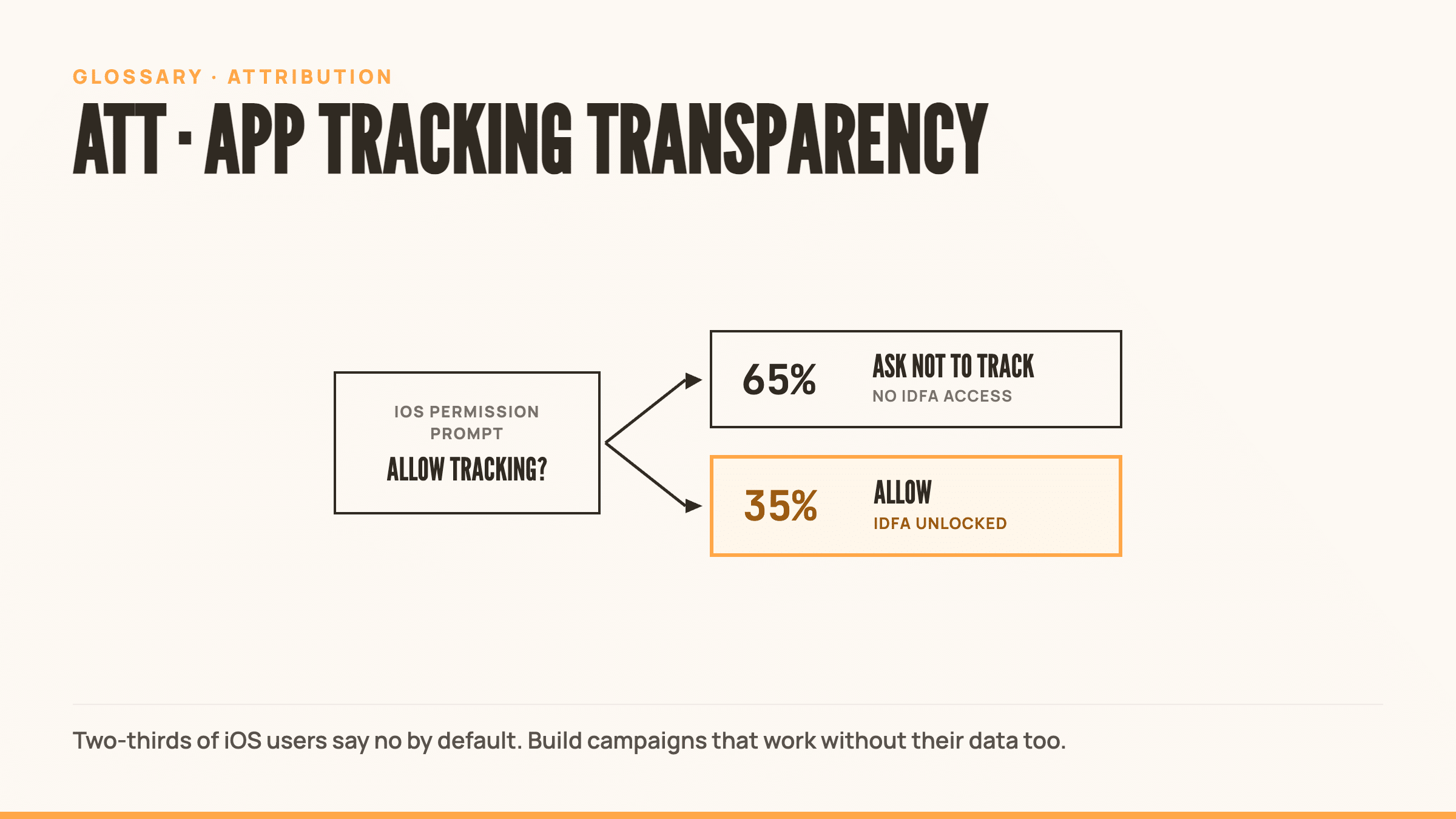
After ATT, every app must show a permission prompt asking users to opt in. No permission means no access to IDFA.
Apple positioned this as protecting user privacy. The ad industry called it a multi-billion dollar disruption.
Both were right.
How It Works
When a user opens an app for the first time (or after updating to iOS 14.5+), they see a system prompt:
“Allow [App Name] to track your activity across other companies’ apps and websites?”
Two options: Ask App Not to Track or Allow.
That choice determines whether the app can access the device’s IDFA for attribution and targeting.
Users can change this setting anytime in iOS Settings > Privacy & Security > Tracking.
Impact on Mobile Advertising
ATT changed everything about mobile UA overnight.
Before ATT:
- Deterministic attribution via IDFA
- Granular audience targeting based on cross-app behavior
- Clear ROI measurement down to individual users
- Performance marketing built on precise tracking
After ATT:
- Majority of iOS users opted out of tracking
- IDFA access dropped sharply, from an estimated 70-90% of users pre-ATT to roughly 25-35% post-ATT, depending on measurement methodology
- Campaigns shifted to probabilistic attribution models
- Ad networks moved to aggregated reporting (SKAdNetwork)
- CPIs increased for many advertisers in 2021-2022 as targeting precision dropped
A 2024 survey showed mixed results: 44% of marketers say ATT negatively impacted UA performance, while 24% reported positive impacts (likely from reduced competition or improved creative focus).
The winners adapted fast. The losers kept waiting for things to go back to normal.
Current Opt-In Rates
As of Q2 2025, global ATT opt-in rates average around 35% across all iOS users, per Adjust’s benchmark data.
Among users who actually saw the ATT prompt, AppsFlyer’s broader panel has shown opt-in rates closer to 46-50% globally (2024 data). The gap reflects different measurement methodology between vendors, not a real swing in user behavior.
Variance by region and vertical:
- Brazil, UAE, and Turkey: Among the highest opt-in markets as of Adjust’s Q2 2025 data, at roughly 50%, 49%, and 42% respectively
- Gaming apps: Typically lower opt-in than utility or social apps
- Premium brands: Higher opt-in rates due to trust
The gap between “all users” and “users who saw prompt” exists because many users disabled tracking at the OS level, never seeing app-specific prompts.
Industry Adaptation Strategies
Mobile advertising didn’t die after ATT. It evolved.
SKAdNetwork (SKAN): Apple’s privacy-preserving attribution framework. Provides aggregated, anonymized conversion data instead of user-level tracking. Campaign optimization now happens at the campaign level, not individual user level.
Contextual Targeting: Targeting based on app content, category, and in-app behavior rather than cross-app tracking. Old-school tactics made new again.
Machine Learning Models: Probabilistic attribution and predictive modeling to fill data gaps. Ad networks like Meta and Google built sophisticated ML systems to estimate performance without deterministic tracking.
Incrementality Testing: Shift from attribution-based measurement to incrementality experiments. Measure lift from campaigns rather than last-click attribution.
First-Party Data: Apps invested heavily in owned data. CRM integration, email capture, in-app analytics, and direct user relationships became critical.
Creative Quality: With targeting constraints, creative became the primary lever. Better creatives = better performance, regardless of targeting precision.
The common thread: teams that could move fast, test more, and improve creative velocity won. Teams stuck in slow production loops lost.
Common Mistakes
Waiting for ATT to be reversed. It won’t be. Apple doubled down. Google followed with Privacy Sandbox. This is the new reality.
Ignoring non-IDFA users. The majority of your iOS traffic has no IDFA. Build campaigns that work for everyone.
Over-relying on SKAN data. SKAN has limitations (delayed data, conversion windows, privacy thresholds). Use it as one signal, not the only signal.
Blaming ATT for all performance declines. Creative fatigue, market saturation, and competition exist regardless of ATT. Don’t use privacy changes as an excuse to avoid fixing creative.
Not investing in creative velocity. When targeting gets harder, creative becomes the advantage. Teams that can explore more concepts faster win.
Related Terms
- IDFA (Identifier for Advertisers): The unique device identifier ATT restricts access to
- SKAdNetwork (SKAN): Apple’s privacy-safe attribution framework
- LAT (Limit Ad Tracking): The pre-ATT iOS privacy setting (deprecated in iOS 14)
- Probabilistic Attribution: Attribution models based on statistical likelihood rather than deterministic device IDs
- Privacy Sandbox: Google’s Android privacy initiative, similar concept to ATT
- Creative Fatigue: Performance decline from ad repetition (amplified post-ATT due to targeting constraints)
External Resources
- Adjust: App Tracking Transparency Glossary
- AppsFlyer: ATT Definition
- Adapty: What is App Tracking Transparency
Frequently Asked Questions
What is the App Tracking Transparency prompt?
The system-level modal iOS shows the first time an app wants to track a user across other apps and websites. Users choose “Ask App Not to Track” or “Allow,” and that choice controls whether the app can access the device’s IDFA.
How do I enable App Tracking Transparency on iPhone?
Go to Settings > Privacy & Security > Tracking. That screen lists every app that requested tracking permission and lets you turn access on or off per app.
Do I need to show the ATT prompt in my app?
Yes, if your app tracks users across other apps or websites for advertising purposes. Apple’s App Store policy requires it.
Does ATT apply to Android?
No. ATT is iOS-only. Google runs its own privacy initiative, Privacy Sandbox, but the implementation is different.